

Last spring I handed my third graders a bag of 190 solar robot pieces and watched what happened. I was expecting chaos. What I got instead was 45 minutes of the deepest focus I had seen all year. Kids who never finished a worksheet on time were still building at recess. That afternoon I texted my husband and said, "I think I have been doing science wrong." If you have ever wondered whether STEM building kits are actually worth the investment, I want to share the 10 reasons I now recommend them to every parent and teacher I know.
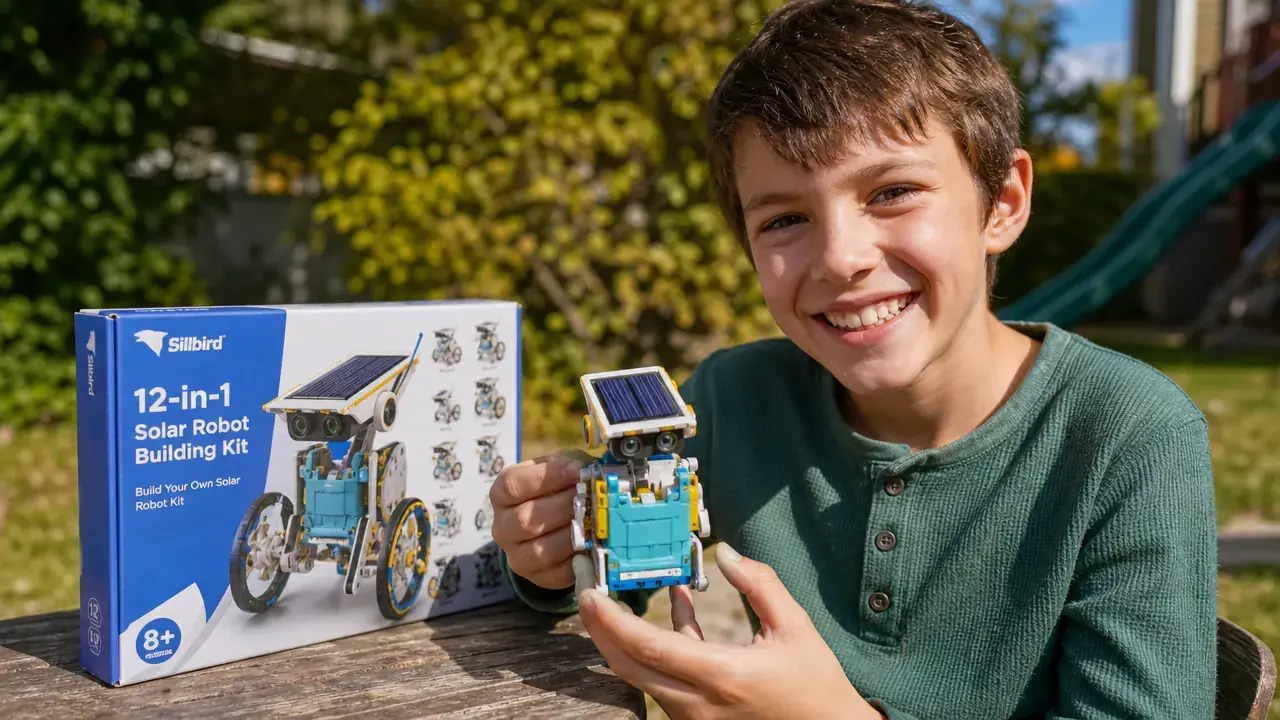
The kit my class used was the Sillbird 12-in-1 Solar Robot Building Kit, a 190-piece set that lets kids build 12 different solar-powered robots from a single box. It is rated 4.3 stars across more than 15,000 Amazon reviews and costs less than a pizza dinner. I have since used it at home with my own two kids, ages 8 and 11, so I can speak to how it works in both settings.
If your kid zones out on worksheets but lights up when their hands are busy, this kit was made for them.
The Sillbird 12-in-1 Solar Robot Kit gives kids 12 different builds from one box, all powered by sunlight. Over 15,000 families have reviewed it on Amazon.
Amazon Check Today's Price on Amazon →Hands-On Learning Sticks Because It Uses Multiple Senses at Once
When a child reads about gears on a worksheet, the information passes through one channel and often walks right back out. When they physically connect a gear, feel the teeth catch, and watch the robot move, three or four sensory pathways fire at once. That redundancy is why my students remembered what a gear train did three weeks later when I never mentioned it again. Building kits create what researchers call embodied cognition, meaning the body itself participates in forming the memory.
They Teach Kids to Read Instructions Without Anyone Nagging Them
My son Marcus, who is 8, refuses to read directions for anything. He opens a toy box and immediately starts improvising. On the first Sillbird build he made that mistake, the robot would not move, and he went back to the instruction booklet himself. Nobody told him to. The desire to make the thing work overrode his resistance to reading carefully. That is a study skill disguised as fun, and it transfers directly to test-taking and project directions at school.
They Make Engineering Concepts Concrete Before Kids Encounter Them Abstractly
Most kids meet concepts like torque, circuits, and solar energy for the first time as vocabulary words in a textbook. If they have already built a working solar panel and felt what happens when they block the light, those words land on a real memory hook. I have seen this play out in my classroom every year I have taught third grade. The kids who have done hands-on builds at home arrive with anchors that let the abstract concepts stick immediately.
The Troubleshooting Process Is Pure Critical Thinking Practice
A worksheet has a right answer. A broken robot build has a sequence of possible causes. When my daughter Lily, who is 11, had a robot that kept running in circles instead of straight, she worked through it systematically: was a wheel shaft in backward? Was the solar panel misaligned? That diagnostic thinking is exactly what critical thinking instruction is trying to teach, except here she was doing it voluntarily, at 9 p.m., because she really wanted the robot to go straight.

They Build Genuine Confidence, Not the Hollow Kind From Participation Trophies
There is no faking a working robot. Either it moves when you point it at sunlight or it does not. When it does move because of choices the child made, that sense of competence is real and specific. In my classroom I watched a boy named Eliot, who struggled with reading and math all year, become the undisputed expert on the Sillbird solar panel alignment. He spent two days teaching other kids how to position it. That kind of confidence does not come from a gold star on a quiz.
Eliot struggled with reading all year. But he became the class expert on solar panel alignment and spent two days teaching other kids. That kind of confidence does not come from a quiz.
STEM Kits Stretch Attention Spans Because the Task Has a Visible End Goal
One of the hardest parts of keeping kids focused on schoolwork is that the payoff is invisible. Study now, do well on a test later, get into college eventually. A building kit collapses that timeline. The payoff is a robot that rolls across the table, and it is 20 minutes away. That tangible finish line keeps attention locked in ways that future-oriented motivation rarely can for kids under 13. Teachers call this proximal motivation, and STEM builds have it built in.
Twelve Builds From One Box Means the Learning Compounds Over Time
The Sillbird kit stands out here. Most STEM toys have one build and then they become a shelf decoration. Twelve different configurations means a child can revisit the same parts with a new challenge, reinforcing what they already know while adding new complexity. My kids built robots 1 through 5 over a weekend, and by build 3 they were anticipating steps instead of just following them. That shift from executing to predicting is a genuine leap in understanding.

They Create Natural Openings for Parent-Child Conversation About How Things Work
Some of my favorite 20 minutes with my kids have happened over a STEM build. Not because I planned a teachable moment but because a question came up organically: why does the robot slow down in the shade? How does the gear make the wheel turn faster? I did not always know the answer, and looking it up together was better than any lesson I could have scripted. Building kits create those questions, and those questions create curiosity habits that persist long after the kit is finished.
They Are an Unusually Good Value Compared to Most Educational Products
I have spent real money on educational apps that my kids forgot about in a week, flashcard sets that got left in a car, and workbooks they filled in reluctantly over a month. The Sillbird kit costs less than most of those and has given us far more actual learning hours. When I think about cost per genuine engagement, it beats almost anything else in the education toy category. That matters when you are trying to stretch a school supply budget across three kids.
They Introduce a Growth Mindset Through Natural Failure and Recovery
You will not complete a 190-piece solar robot build on the first try without a mistake. That is by design, even if the designers did not plan it that way. The mistake happens, it is inconvenient, you figure out what went wrong, and you keep going. Psychologists call this productive struggle, and research consistently shows it is one of the most powerful predictors of long-term academic resilience. Worksheets rarely offer productive struggle because there is nothing to rebuild when you get an answer wrong.
What I Would Skip
Not every STEM building kit lives up to this list. I have bought a few that had missing pieces, instructions with no English translation, or parts so flimsy they broke on the first build. Those kits do not produce the outcomes above. They produce frustration and a trip to the recycling bin. Before you buy any kit, check that it has a large number of verified reviews, that the brand offers customer support, and that the instruction booklet includes clear diagrams. The Sillbird kit passes all three of those checks, which is a big part of why I keep recommending it specifically. If you want to see how the full build experience holds up over multiple uses, my detailed long-term review of the Sillbird 12-in-1 kit walks through exactly that. And if you are ready to turn one of these builds into a full lesson plan, the step-by-step guide on teaching kids basic engineering concepts using a solar robot kit gives you a structured framework for both home and classroom.
A 190-piece solar robot build will not go perfectly on the first try. That is not a flaw. That productive struggle is exactly what builds long-term academic resilience.
Ready to put one of these kits in your child's hands this week?
The Sillbird 12-in-1 Solar Robot Building Kit is consistently one of the top-rated STEM toys on Amazon, with over 15,000 reviews and 190 pieces that build 12 different solar-powered robots. It works indoors near a sunny window and outdoors in full sun.
Amazon Check Today's Price on Amazon →