

My son Eli, who just turned nine, has been on a STEM kick since we started doing after-school builds together last fall. When his birthday rolled around, I had two kits sitting in my Amazon cart: the Sillbird 12-in-1 Solar Robot Building Kit and the Snap Circuits Jr. SC-100. I ended up buying both, because I could not resist, and because I teach third grade and wanted something I could evaluate for my classroom too. After six weeks of watching Eli work through both, and after running the Sillbird through two rounds with my students, I have a pretty clear picture of which kit does what best and who should buy which.
The short answer: the Sillbird Solar Robot Kit wins on real-world science connection, outdoor play, and price. The Snap Circuits Jr. wins on reusability, stepwise challenge progression, and pure electronics depth. They are not really competitors so much as cousins covering different corners of STEM. But if you can only buy one, I'll tell you exactly which to pick and why.
| Sillbird 12-in-1 Solar Robot Kit | Snap Circuits Jr. SC-100 | |
|---|---|---|
| Price (current) | ~$20 | ~$35 |
| Piece count | 190 pieces | 30 components, 60+ parts |
| Recommended age | 8 to 13 | 8 and up |
| Power source | Solar panel (no batteries) | AA batteries required |
| Number of builds | 12 robot configurations | 100+ circuit projects |
| Reusability | Moderate (reassemble into new forms) | High (snap-apart, fully modular) |
| Skill focus | Mechanical assembly, solar energy, physics | Electronics, circuits, basic electricity |
| Adult help needed | Yes, for first 2-3 builds | Minimal after initial setup |
| Classroom-friendly | Yes, with supervision | Yes, highly portable |
Where the Sillbird Solar Robot Kit Wins
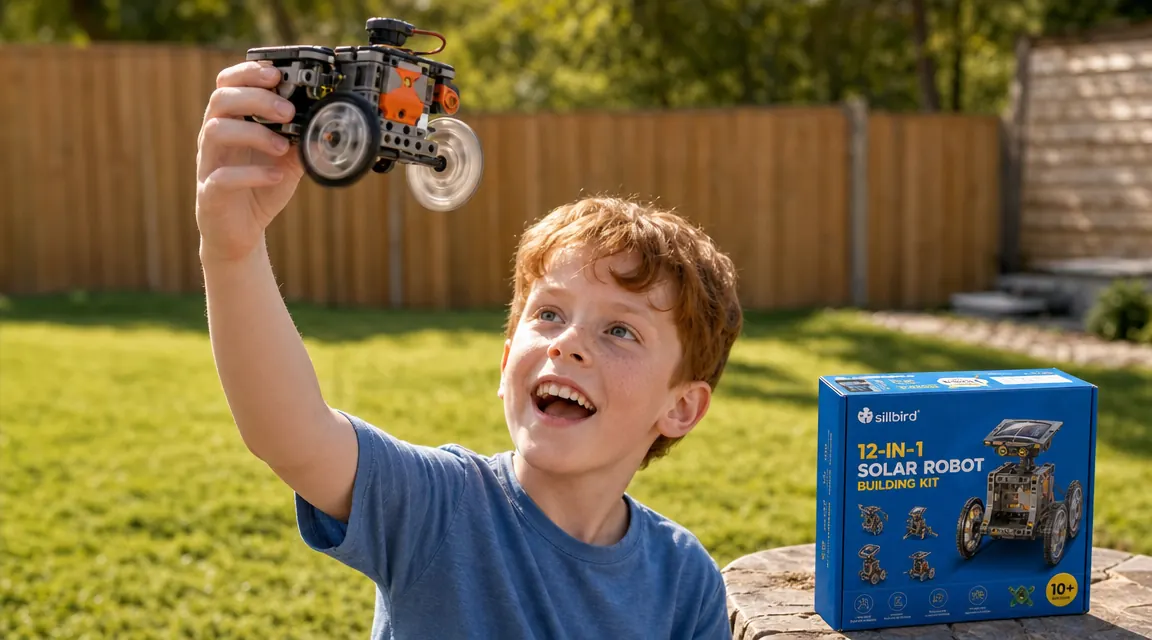
The first and most obvious win for the Sillbird kit is the price. At around twenty dollars, it is one of the most affordable hands-on STEM toys I have seen that actually delivers a functioning, moving product at the end. Eli built the walker configuration on a Saturday morning, carried it outside, held it up to the sun, and watched the legs move. That moment, the motor spinning because of actual sunlight, not a battery he cannot see, is something no circuit board can replicate. He got it immediately. That is solar energy. That is why it matters.
The kit also wins on the physical, tactile experience of mechanical assembly. With 190 pieces spread across 12 configurations, kids are working with screws, motors, gears, and structural components in a way that builds genuine spatial reasoning. In my classroom, I noticed even kids who usually disengage during science time stayed focused when their hands were busy sorting and connecting parts. The instruction manual is detailed with numbered steps and clear diagrams, which means kids can lead themselves through the build once they have done one or two with an adult. For classroom use, I paired students in twos, and both kids stayed engaged for the full 40-minute block.
Where the Snap Circuits Jr. Wins
Snap Circuits is a harder kit to beat on long-term value, and I want to be honest about that. The 100+ projects in the SC-100 keep kids busy for months, not weeks. The snap-together design means there is no assembly frustration, no tiny screws rolling off the table, and no moment where a kid declares the kit broken when they have simply misaligned a gear. For an independent learner who wants to self-direct, Snap Circuits is forgiving in a way that the Sillbird kit is not.
The electronics depth is also more real. By project 30 or so in Snap Circuits, kids understand series versus parallel circuits, they have made a light blink and a buzzer sound, and they have started to understand that the wiring layout matters, not just which parts you use. That conceptual progression is genuinely well-designed. If you have a kid who is gravitating toward computing or robotics long-term, the electronics vocabulary Snap Circuits builds is genuinely useful down the road.
Want a solar STEM kit that gets kids outside AND teaches physics without a single battery?
The Sillbird 12-in-1 Solar Robot Building Kit is under $20, has 190 pieces, and produces 12 different working robots powered entirely by sunlight. It is the kit I recommend for kids ages 8 to 12 who learn best by building something real.
Amazon Check Today's Price on Amazon →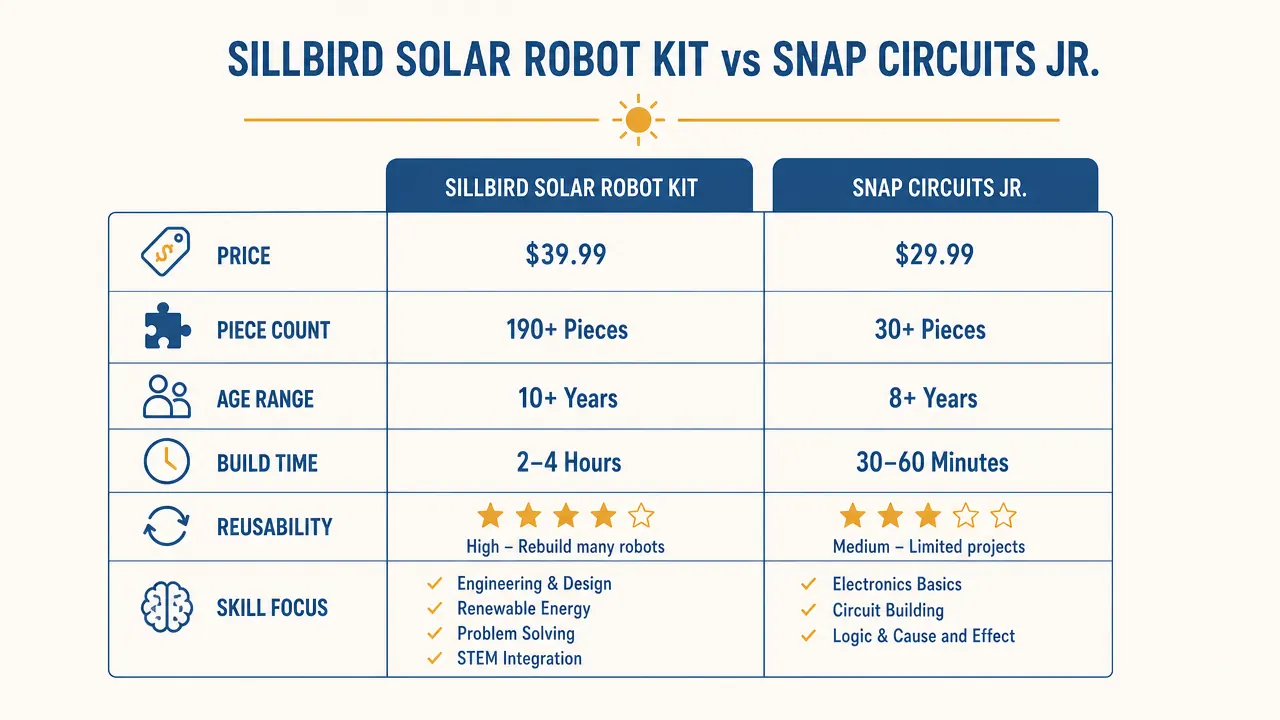
The Solar Energy Factor: A Bigger Deal Than It Sounds
I want to spend a minute on the no-battery thing because I do not think it gets enough credit in most reviews. The Sillbird kit runs entirely on a solar panel. No AA batteries, no USB charging, no power pack. You take it outside and it works when the sun hits the panel. This is a remarkable teaching moment that I have used in my classroom as a jumping-off point for a whole unit on renewable energy. When kids ask why it slows down on a cloudy afternoon, they are asking a question that engineers and climate scientists deal with every day. That is a real conversation. Snap Circuits, despite its many strengths, runs on batteries and does not open that door.
When Eli carried his finished walker outside and held it up to the sun and the legs started moving, he looked at me like he had discovered something. And he kind of had.
I also love that the Sillbird kit encourages outdoor use. Most educational toys are designed for the kitchen table, and that is fine, but getting kids outside to test something they built is a different kind of engagement. We took the kit to a local park on a clear afternoon and tested all three movement configurations in direct sunlight versus partial shade. Eli filled in a little chart I made. That was science class, and neither of us called it that.

Honest Look at the Drawbacks of Each
The Sillbird kit has real frustrations. The small screws are genuinely tiny and will roll off the table, go under the couch, and disappear. For kids under 8 or 9, the fine motor demands of some steps are legitimately hard, and a frustrated child will want to quit before the robot moves. The instruction manual, while visual, is not perfect, and a few steps had Eli and me both stumped for a few minutes on our first build. I would say expect one to two hours on the first configuration with an adult present, not the 45 minutes the box suggests.
Snap Circuits has its own friction. The projects near the end of the SC-100 booklet are conceptually harder than the early ones, but the jump in difficulty is not always graduated evenly. Some kids hit a wall around project 50 and need an adult to explain what a transistor does before they can proceed. If your child is independent and self-motivated, that wall can feel discouraging rather than challenging. The components are also color-coded and labeled, which is fantastic for beginners, but can make kids reliant on the labeling system rather than actually understanding what each component does.
Who Should Buy Which
Buy the Sillbird Solar Robot Kit if your child is between 8 and 12, loves the outdoors, gets excited by physical things that move, and you want a STEM tool that doubles as a lesson in renewable energy. It is also the right call if budget is a concern, if you want something for a classroom setting, or if you are buying a gift for a kid whose interest level is uncertain. At around twenty dollars, the cost of a wrong guess is low. I have recommended it to three other teachers in my building, and all three bought it for their classrooms.
Buy Snap Circuits Jr. if your child is a self-directed learner who wants to work independently through a long progression of increasingly complex projects. It is the better pick for a kid who has already outgrown basic STEM toys and is asking questions about how phones and computers work. If your child is 10 or older and already curious about electronics specifically, the SC-100 is a better long-term investment even at the higher price.
If you have budget for both, buy the Sillbird first. It is the better entry point for kids who have never done a serious STEM build. After they finish all 12 configurations and understand that motors and solar panels are real science, they will be more ready to appreciate what Snap Circuits teaches about circuits. The sequence matters.
The Sillbird Solar Robot Kit: the STEM gift that works without batteries and gets kids off the couch.
Under $20, 190 pieces, 12 different robot builds, no batteries ever. If you are buying one STEM kit this year for a kid ages 8 to 12, this is the one I'd put in the cart first. It is what I bought for my classroom, and what I would buy again.
Amazon Check Today's Price on Amazon →