

Every fall I see the same scene in my classroom: kids arrive in September who have logged thousands of hours on family tablets, and when I ask them to focus on a single task for five minutes, they struggle. Not because they are not smart. Because the devices they grew up with trained them to swipe away the moment something gets hard. I have been a third-grade teacher for eleven years, and I have also raised three kids through the ages of three to eight. I have watched both my own children and my students use regular tablets, learning tablets, and everything in between. The LeapFrog LeapPad Academy (ASIN B07PLG93NS, currently 4.4 stars from nearly 6,000 families) keeps coming up as the clearest dividing line I know between a device that teaches and a device that just entertains.
If you are weighing a regular tablet against a dedicated learning device for a child between three and seven, here are the ten reasons I keep coming back to the LeapPad, backed by what I have seen at kitchen tables and in classroom centers.
If your kid is under 7 and you want screen time that actually builds skills, this is the one I point every parent toward.
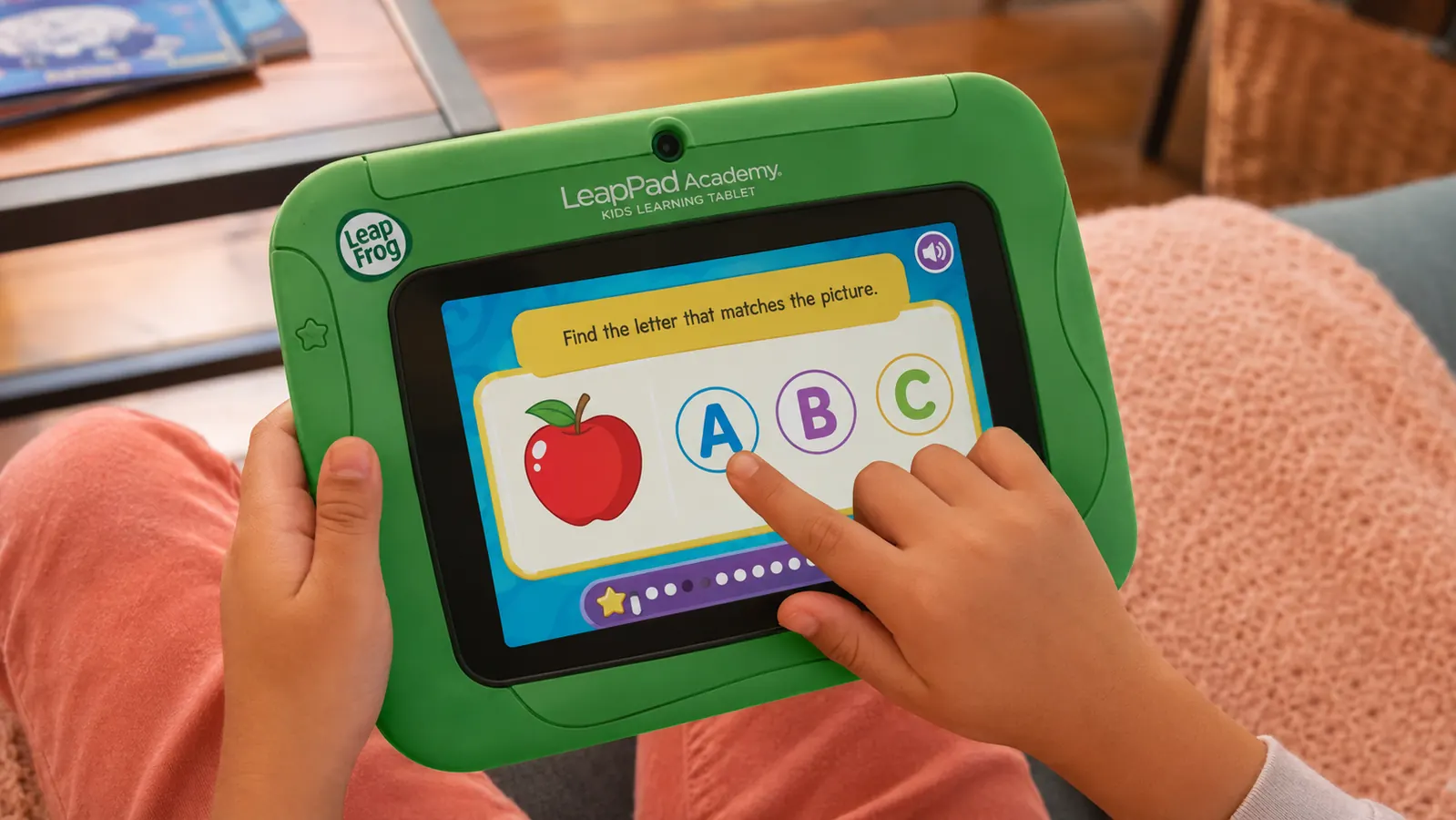
The LeapFrog LeapPad Academy is purpose-built for learning, not browsing. No app store rabbit holes, no YouTube autoplay, no accidental in-app purchases. Just curriculum-aligned content for ages 3 to 7.
Amazon Check Today's Price on Amazon →Every App on It Was Designed to Teach Something Specific
Open a regular tablet and you get a store with 2 million apps, maybe 30 of which are genuinely educational. On the LeapPad, the entire library is curriculum-aligned. LeapFrog's in-house team built every game around phonics, numeracy, or problem-solving progressions. My daughter Mia, who was four when she started using it, was reading three-letter words by spring. I cannot say a free app from the App Store would have gotten her there.
There Is No YouTube, No App Store, No Rabbit Holes
This is the one parents in my class text me about most. On a Fire or iPad, a four-year-old can go from an alphabet game to unboxing videos in about forty-five seconds if you leave the room. The LeapPad is a closed system. There is no browser, no YouTube app, no social media. What is on the device is what they can do. Parents consistently tell me this alone is worth the price.
It Is Built for Small Hands and Drop-Happy Ages
The rubberized bumper case on the LeapPad is not decorative. My son Owen dropped his off the kitchen counter at age five and the screen survived. Regular tablets sold for kids usually require a separate case purchase that adds bulk and does not always protect the corners that actually hit the floor. The LeapPad ships ready to take the abuse a five-year-old will give it.
Parental Controls Are Simple and Actually Work
I have set up parental controls on Fire tablets, iPads, and Android devices. On all of them, there is a gap between the controls you think are on and what a curious six-year-old actually finds their way around. The LeapPad's controls are hardware-level: what is loaded is what is available, period. No password guessing, no glitches, no accidental unlocks. For busy parents, simpler is more reliable.

It Adapts to Where Your Child Is, Not Where the App Assumes They Are
Many of the LeapPad learning apps have built-in difficulty adjustment. When Mia breezes through a phonics level it pushes her to the next one. When Owen got stuck on two-digit addition it slowed down and gave him more practice problems without making him feel like he failed. That kind of responsive scaffolding is rare on free apps and usually costs a monthly subscription on regular tablets.
I have watched both my own kids and 24 students use this device. The ones who started on the LeapPad came into kindergarten with stronger phonics foundations than any group I have seen in eleven years.
Screen Time Becomes Learning Time, Not Just Quiet Time
I want to be honest here: most parents, including me, sometimes hand over a tablet because we need fifteen minutes of peace. The LeapPad gives you that same fifteen minutes, but the child comes back having practiced letter sounds instead of watching someone else play video games. That is not a small thing when you add it up over weeks and months.
No Accidental Purchases, Ever
I had a parent in my class last year whose five-year-old spent $60 on in-app currency over a single weekend on a regular tablet. Every parent I know has a version of this story. The LeapPad has no in-app purchases. Additional content packs are physical cartridges that require a grown-up to actually go buy them. That friction is a feature.

It Covers the Actual Subjects Your Child Needs Before Kindergarten
LeapFrog partners with education consultants to align content to pre-K and kindergarten readiness standards. The device covers phonemic awareness, sight words, counting, shapes, and basic science concepts, which maps almost exactly to what I assess when new students arrive in September. A child who has spent six months on a LeapPad is measurably more prepared than one who has spent the same time on entertainment apps.
Battery Life That Lasts a Car Trip
Regular tablets typically get three to five hours of active use. On a long drive to visit my parents, that means managing the charger situation while also driving. The LeapPad gets through a full road trip day on a charge. When we drove eight hours to see my in-laws last Thanksgiving, both kids used it in stretches and we did not need to plug in once.
It Builds Healthy Device Habits Early
This might be the one that matters most in the long run. When a child learns to use a device that has a purpose, start and end points, and a focus, they develop a healthier relationship with screens than kids who grow up with infinite-scroll entertainment devices from age three. I have no scientific citation for this, only eleven years of watching kids and three of my own. The LeapPad teaches children that screens are tools, not treats.
What I'd Skip
The LeapPad does have a ceiling. Once kids hit around age seven or eight, they outgrow it fast. The content library stops feeling fresh, and kids that age are ready for more complex tasks a general tablet handles better. I would not buy it for a six-year-old who already reads chapter books. The sweet spot is ages three through six, with the strongest value in the year or two before kindergarten. If your child is already reading at a second-grade level, the LeapPad's reading content will feel too easy within a few weeks.
For a deeper look at how it holds up month after month, read my full five-month review: LeapFrog LeapPad Academy Review: 5 Months of Daily Use by a 5-Year-Old. And if you are comparing it directly to the Amazon Fire Kids tablet, I break down every meaningful difference in LeapFrog LeapPad Academy vs Amazon Fire Kids Tablet: Which Should You Buy?.
The LeapPad does one thing that no general-purpose tablet does: it makes it easy to say yes to screen time without second-guessing yourself.
Ready to swap entertainment screen time for learning screen time? The LeapPad is where I would start.
With nearly 6,000 reviews and a 4.4-star average, the LeapFrog LeapPad Academy is the most trusted dedicated learning tablet in this age range. Purpose-built content, kid-tough case, no rabbit holes, no surprise charges.
Amazon Check Today's Price on Amazon →