
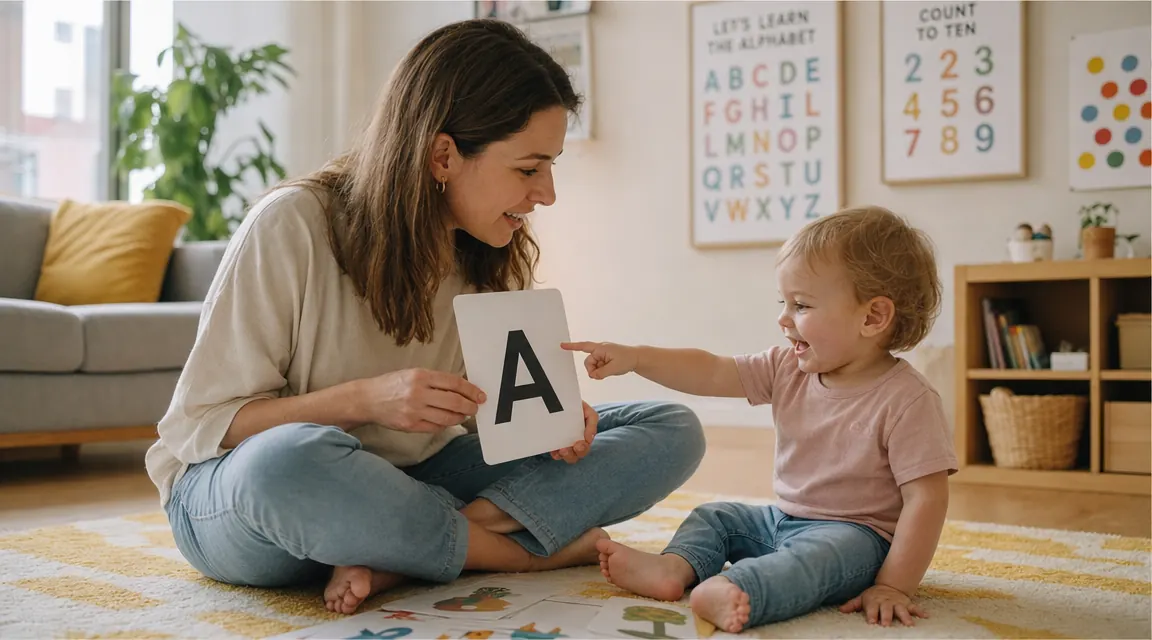
I have been a third-grade teacher for eleven years, and I have three kids of my own. My youngest, Mia, just turned two in March. So when it came time to try flash cards with her, I was not flying blind. I had watched dozens of toddlers at every developmental stage. I knew what worked. And I still managed to make every beginner mistake in the first week. The deck I keep coming back to for this is the Carson Dellosa Toddler Flash Cards 4 Pack, because the images are clean and the categories stay consistent.
I sat her down at the kitchen table, pulled out a stack of alphabet cards, and started flipping through them like a Vegas dealer. She lasted about forty-five seconds before she grabbed the stack, threw it on the floor, and wandered off to find the cat. That was my fault, not hers. Flash cards are a fantastic tool for toddlers, but only when you use them the right way. The wrong approach turns learning into a power struggle. The right approach turns it into a game your toddler will ask to play again tomorrow morning. Here is exactly how to get there.
If your toddler tunes out during learning time, the cards might not be the problem
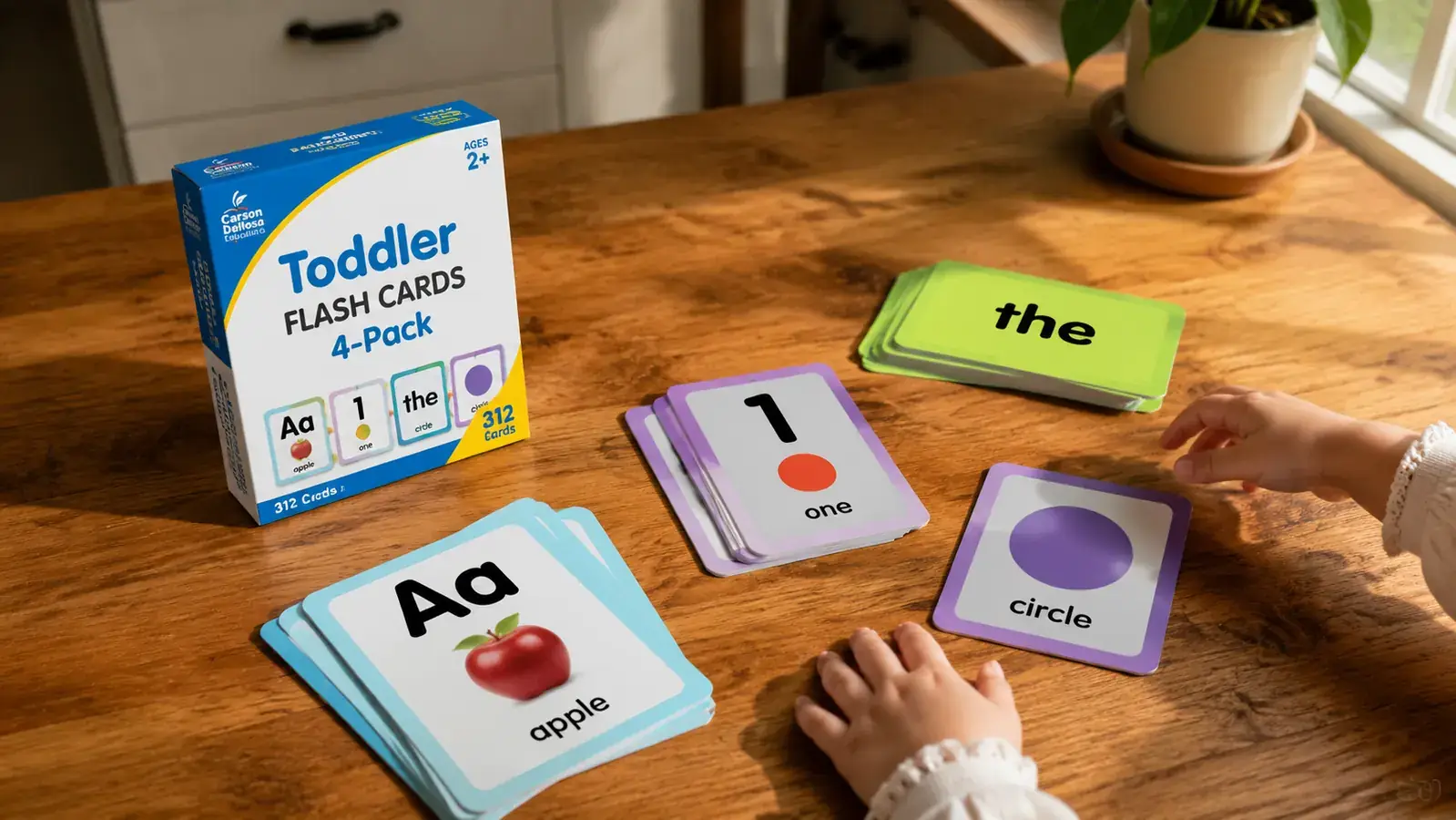
The Carson Dellosa Toddler Flash Cards 4-Pack covers alphabet, numbers, colors, and sight words in one set. Bright illustrations, durable card stock, and a ring to keep them organized. It is what I use with Mia and recommend to parents in my class.
Amazon Check Today's Price on Amazon →Step 1: Choose the Right Set for Your Child's Age
Not all flash cards are built for toddlers. Many sets designed for preschoolers have too much visual clutter: small fonts, busy borders, multiple elements per card. A two-year-old's brain is still learning to isolate and name a single object. The card needs one large, clear illustration and one short word. That is it.
For toddlers ages one to four, I consistently reach for the Carson Dellosa Toddler Flash Cards 4-Pack. It includes four separate decks: alphabet, numbers, colors and shapes, and basic sight words. Each card has a bold illustration sized for small hands to hold and examine. The card stock is thick enough to survive a toddler's grip without bending. The ring connector keeps each deck intact so cards do not scatter across your living room floor every single session. For kids twelve to eighteen months, start with just the colors and shapes deck. The categories are concrete and the images are easy to match to real objects in your house. Save letters and numbers for after the second birthday when abstract symbol recognition starts to click.
Step 2: Time It Right
Timing is probably the single biggest factor parents overlook. I have seen it in my classroom and I have lived it at home. A toddler who is hungry, tired, or overstimulated is not going to retain anything. You will get fussiness and tears and conclude that flash cards do not work. They work fine. The timing was just off.
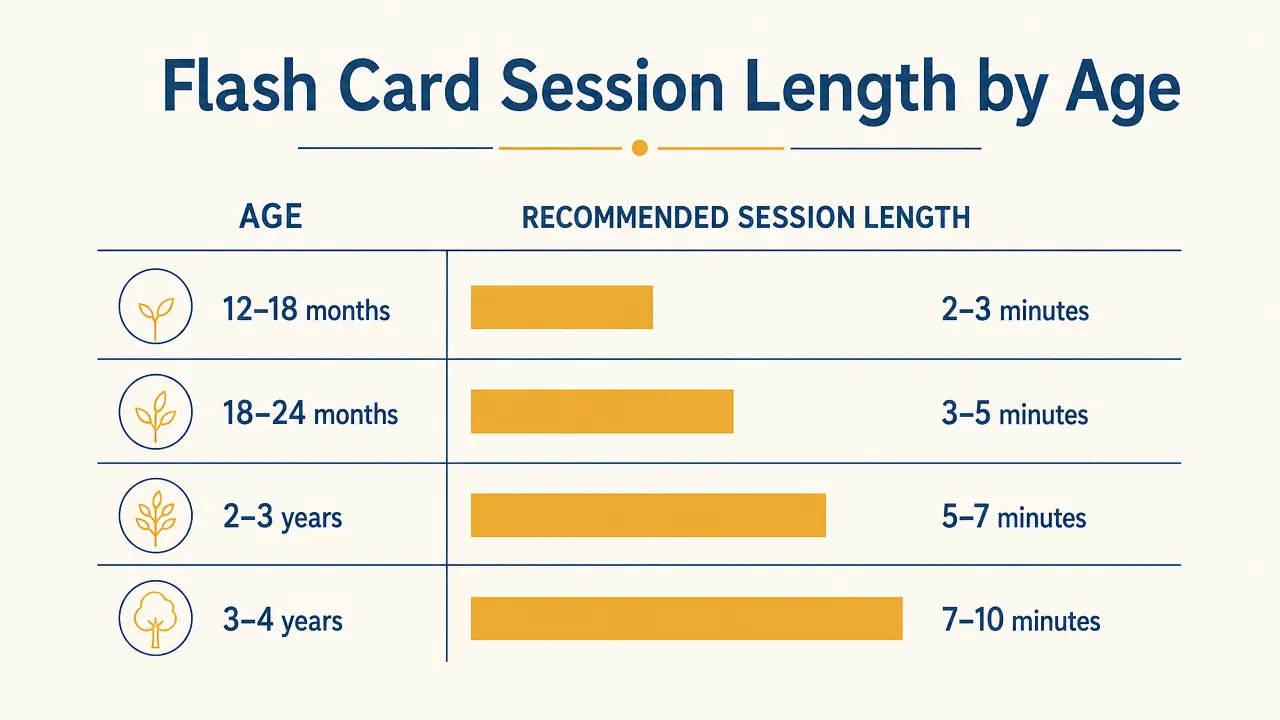
The best window is about thirty minutes after a nap or after a small snack, before the next meal. For most toddlers, mid-morning between nine and eleven tends to be the sharpest. Avoid the witching hour before dinner at all costs. Mia and I do our card time right after her morning snack while her older sister is doing reading homework. It feels like Mia gets her own special learning time, which she loves. Keep sessions short: two to three minutes for kids under eighteen months, five to seven minutes for two-year-olds, up to ten minutes by age three and four. Stop before they want to. Ending while engagement is still high is the fastest way to build a habit they look forward to.
Step 3: Set Up the Space to Reduce Distractions
Toddlers have no filter for background noise. The TV playing in the other room, a sibling arguing nearby, a phone buzzing on the counter, all of it competes directly with what you are trying to teach. For flash card time to work, the space needs to be calm and simple. You do not need a dedicated classroom. The floor of the living room is fine. A corner of the kitchen table works. Just remove visual clutter from arm's reach so the cards themselves become the most interesting thing in the environment.
Sit at the toddler's level, not above them. Get on the floor or pull up a child-sized chair. Face-to-face contact matters for engagement. Toddlers learn from watching your face, your mouth movements, and your expressions as much as from the card itself. When I hold up a card and say the word with exaggerated enthusiasm, Mia mirrors my expression before she tries to repeat the sound. That mirroring is part of how word-to-object connections are built.
Step 4: Use the Show-Say-Play Method
Here is the specific technique I use, both at home and with early learners in my classroom. I call it show-say-play, and it takes a session from passive memorization to active participation in about thirty seconds.
Show: Hold up the card clearly at the child's eye level. Give them two to three seconds to look at the image before you say anything. Toddlers process visually first. Let them look. Say: Name the card with a short, clear sentence. For the letter A card, I say, 'This is the letter A. A is for apple.' Then I pause and give Mia a chance to repeat it. No pressure. If she says nothing, I just repeat it warmly and move on. Play: After showing four or five cards, do a quick game. Spread three cards on the floor and ask, 'Can you find the apple?' Watch them light up when they locate the right card. This active retrieval step is what actually moves information from short-term attention into memory. It also makes the whole thing feel like a treasure hunt instead of a test.
Step 5: Rotate Cards and Layer in New Ones Gradually
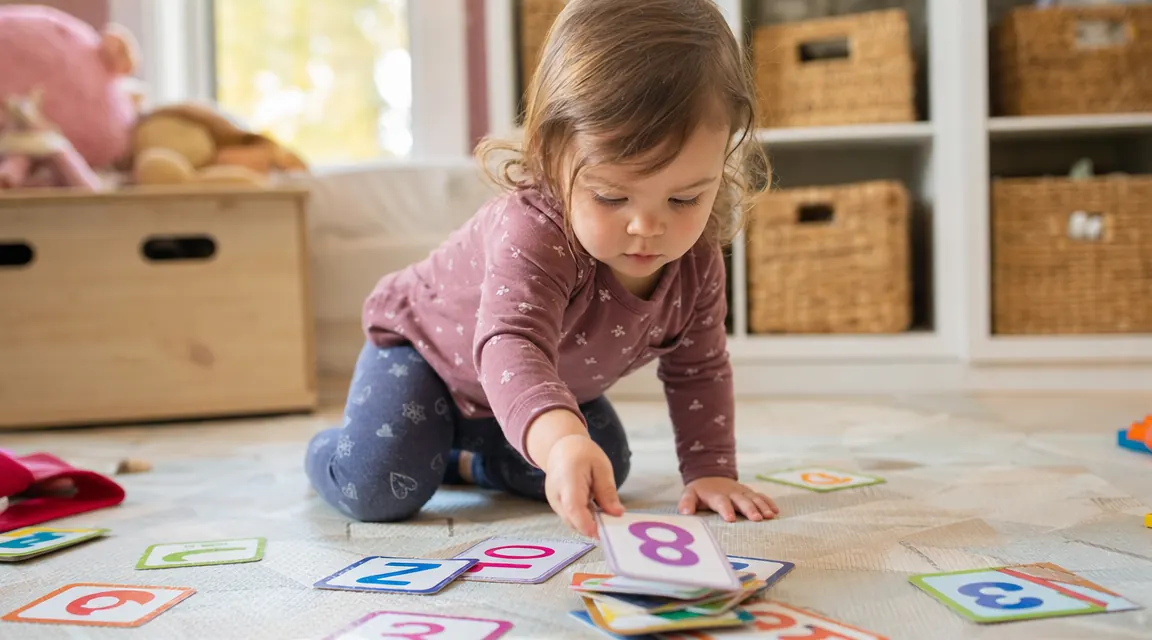
One of the mistakes I made with Mia in week one was trying to go through the entire alphabet deck in one session. All twenty-six cards. She checked out at card seven. Toddlers do not need breadth. They need repetition. Early childhood research consistently shows that a child needs to encounter a new word eight to fifteen times in different contexts before it becomes reliable vocabulary. With flash cards, that means seeing the same small set of cards across multiple short sessions before adding new ones.
My rule: start with five cards. Once your toddler can name at least three of those cards without a prompt, swap one out for a new card and keep four familiar ones. Always keep a high ratio of known cards to unknown cards so the session feels mostly like winning, with just a small stretch. With the Carson Dellosa 4-Pack, I work one deck at a time and build up slowly. After about six weeks of daily sessions with Mia, she could name all ten number cards and twelve letters without a prompt. That is real progress from five minutes a day.
What Else Helps
Flash cards do their best work when they connect to the real world outside the session. After we go through the number cards, I ask Mia to count the cats. We have three. She holds up fingers. She matches the number three card to the real three cats sitting on the couch staring at us. That connection between symbol and real object is exactly what makes early math stick. Do the same with alphabet cards: find the letter on the cereal box, on the street sign outside, on the book spine. The card becomes a key that unlocks everything labeled in your child's environment.
Reading aloud daily also accelerates what flash cards teach. When Mia hears a sight word in a picture book an hour after seeing it on a card, that second exposure reinforces the pattern. Flash cards and bedtime reading are not separate activities. They are two parts of the same learning system.
Stop before they want to. Ending a session while engagement is still high is the fastest way to build a habit your toddler will ask for by name tomorrow morning.
A good card set makes the routine easier to stick with
The Carson Dellosa Toddler Flash Cards 4-Pack includes four complete decks: alphabet, numbers, colors and shapes, and sight words. Each deck comes on a ring so nothing gets lost, and the card stock holds up through the repetition toddlers need. This is the set I recommend to every parent at meet-the-teacher night.
Amazon Check Today's Price on Amazon →