

Last August, my daughter Lily started 5th grade. She is ten years old, sharp as a tack in science, but two grades behind in reading comprehension and shaky on fractions. When we pulled her out of public school to homeschool this past year, I knew I needed something comprehensive, something I could hand her every morning without building my own curriculum from scratch. I teach 3rd grade myself, so I know what good grade-level content looks like. And after a full 180-day school year with the Carson Dellosa Comprehensive Curriculum of Basic Skills for 5th Grade, I have a lot to tell you.
This is not a quick flip-through review. We used this workbook from September through May, Monday through Friday. Lily completed every section. Some pages were a fight. Others she flew through. By the end, she had filled 704 pages and I had a clear picture of where this book earns its reputation and where it falls short.
The Quick Verdict
An honest, thorough all-in-one 5th grade workbook that delivers solid math, reading, and grammar coverage at a price point that makes most curriculum subscriptions look absurd.
Amazon Check Today's Price →If you are drowning in curriculum decisions, this is the one book that covers everything for under $15.
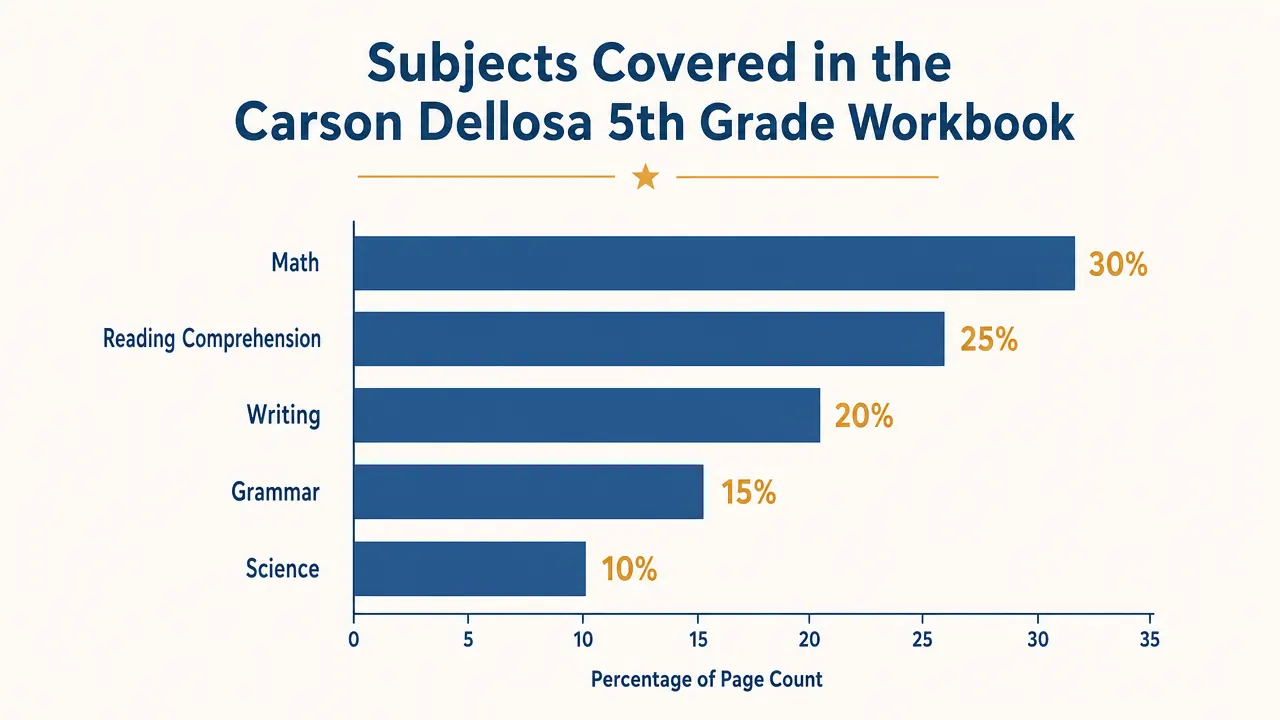
The Carson Dellosa 5th Grade Comprehensive Curriculum covers math, reading comprehension, writing, grammar, and science in a single softcover book. Over 1,900 reviewers rate it 4.7 out of 5 stars.
Amazon Check Today's Price on Amazon →How We Used It
Our school day starts at 8:30 a.m. after we feed the cats and take a short walk around the block. Lily sits at our kitchen table while I make coffee, and she opens the workbook to wherever we left off. We do two to four pages per subject per day, which takes roughly 45 minutes per subject. The book is not meant to be your only resource, something I will revisit later, but it works beautifully as your primary daily structure.
Because I am a teacher, I paced it carefully. I spread the math sections across the year to mirror a typical classroom scope and sequence: whole number operations in September, fractions and decimals through the fall, geometry and measurement in winter, and a data and probability sprint in the spring. Reading comprehension ran parallel throughout, and we wove grammar into every writing session. Having everything in one spine meant we were not hunting for supplemental materials every week.
The physical format held up well. The binding stayed intact through daily use. Lily is not exactly gentle with books, and she also used this one as a lap desk twice during a camping trip in October. No pages fell out. The paper weight is reasonable for pencil and pen, though heavy marker bleed-through is a real issue if your child likes thick markers. We stuck to pencil for almost everything.
What Is Actually Inside the Book
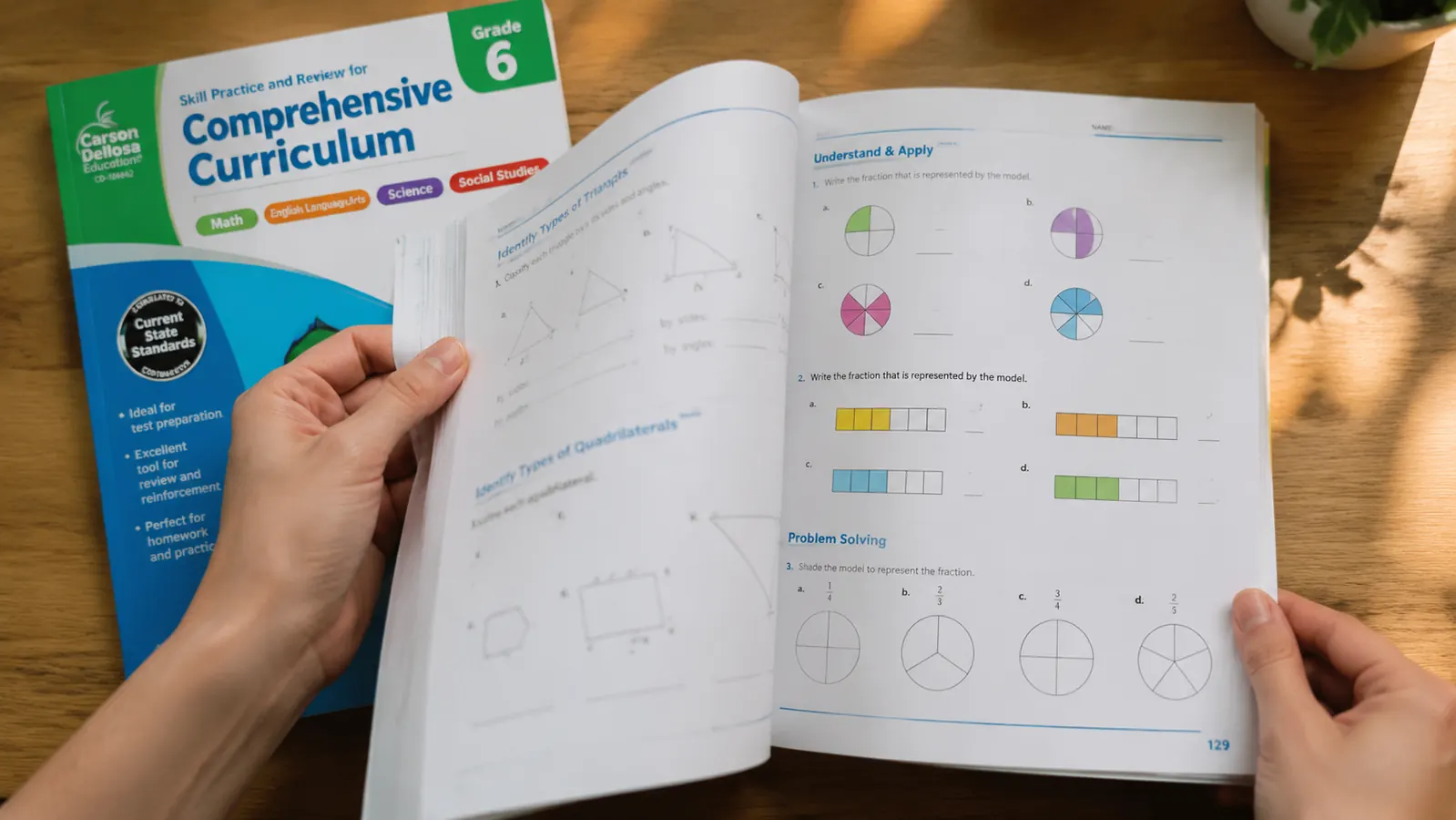
The full title is the Comprehensive Curriculum of Basic Skills, Grade 5, and that word comprehensive is genuinely earned. The book covers: multi-digit multiplication and division, fractions and mixed numbers, decimals and percentages, geometry fundamentals, measurement and data, reading comprehension passages with inference and main idea questions, writing mechanics, grammar (parts of speech, sentence structure, punctuation), and an introductory science strand.
Each skill gets a short introduction at the top of the page, usually two to four sentences, followed by a practice set. The instructions are written for the child, not the parent, which I appreciated. Lily could read the directions and start working without me hovering. When I compared the reading comprehension passages to the leveled readers I use in my classroom, the text complexity tracked correctly for 5th grade. The questions lean toward literal comprehension and some inference, which is appropriate for this grade but will not challenge a very advanced reader.
The math progressions are solid. Fractions go from conceptual models to unlike denominators to mixed number operations in a logical sequence. I did add a few supplemental fraction drills in December because Lily needed more repetitions than the book alone provides, but the conceptual scaffolding was already there. The geometry section covers area, perimeter, volume, and basic coordinate plane work, which matches what I see my own students preparing for in late elementary.
By April, Lily was reading chapter books for fun again for the first time in two years. I credit the consistent comprehension practice more than anything else we tried.
Where It Performed Better Than I Expected
The reading comprehension strand was the biggest surprise. Lily came into this year resistant to reading. She could decode fine but she hated stopping to answer questions about what she had read. The passages in this workbook are short enough, usually half a page, that she never felt trapped. The questions ask her to return to the text, which built a genuine close-reading habit over time. By April, she was reading chapter books for fun again for the first time in two years. I cannot prove causation, but daily low-stakes comprehension practice changed her relationship with reading.
The grammar sections are also stronger than I expected for a multi-subject workbook. They are not just fill-in-the-blank drills. Several pages ask students to revise a paragraph for clarity or combine sentences, which is much closer to authentic writing instruction. I use similar approaches in my classroom, and I was genuinely impressed to see them in a $13 book.
Where It Falls Short
The science section is thin. I will say that plainly. It covers some basic life science, earth science, and physical science vocabulary at a surface level, but it is not enough to stand alone as a science curriculum. We supplemented with library books and a few online videos throughout the year. If science is a priority for your family, plan to add more.
The workbook also does not include an answer key in the back. This surprised me, because I expected one. You either need to purchase a separate answer key or check answers as you go. For parents who are not comfortable with 5th grade math themselves, that gap matters. I knew the content well enough to check it in my head, but I hear from other homeschool parents regularly that the missing answer key is their biggest frustration. Carson Dellosa does sell a companion answer key separately, so factor that into your total cost if needed.
Finally, the book covers all subjects at a standard grade level but does not differentiate. If your child is significantly behind in one subject and ahead in another, you will need to supplement or skip around. That is not a flaw exactly, it is just the nature of a single-grade comprehensive workbook, but I think it is worth knowing before you buy.
What I Liked
- Covers all core 5th grade subjects in one affordable book
- Child-readable instructions let kids work independently
- Strong reading comprehension strand with genuine inference practice
- Grammar sections include revision work, not just drills
- Binding held up through a full year of daily use
- 4.7 stars across nearly 2,000 reviews on Amazon
Where It Falls Short
- No answer key included (sold separately)
- Science strand is too thin to stand alone as a full curriculum
- Does not differentiate for mixed-level learners within the same grade
- Heavy marker bleed-through on thinner pages
Comparing It to the Other Options I Considered
Before settling on this book, I looked seriously at Spectrum Workbooks and at a few digital subscription platforms. Spectrum's individual subject workbooks are well made and I recommend them for targeted practice, but buying separate books for each subject adds up quickly and you lose the integrated pacing. At around $13 for everything, the Carson Dellosa all-in-one option made sense for a first full year of homeschooling when I was still figuring out our rhythm.
The digital subscriptions I looked at ranged from $30 to $80 per month. Some had good content. But Lily does not learn well on screens for more than 20 minutes at a time, and I noticed that when she worked on paper she retained material better. That observation from my own teaching informed the decision too. There is still real research behind pencil-to-paper practice for retention at this age.

Who This Is For
This workbook is an ideal fit for a homeschool family starting out and wanting a single, structured resource that covers all core subjects without a steep price. It works well for a child who can read independently and follow written instructions. It is also a strong supplemental tool for parents who want to shore up grade-level skills over a summer or during school breaks. If your child is at or near grade level in most subjects and you want consistent daily practice, this book will serve you well for a full year.
Who Should Skip It
If your child needs a rigorous, differentiated curriculum or is more than a grade level behind in math, you will likely need a dedicated math program alongside this book. It is also not the right fit if science is central to your homeschool identity, because that section simply will not satisfy you. And if you need a built-in answer key for your own confidence, budget for the companion key or look at options that include one. None of these are dealbreakers for most families, but they are real limitations worth knowing.
Under $15 for a full year of 5th grade across every core subject. That is hard to argue with.
After 180 days with the Carson Dellosa 5th Grade Comprehensive Curriculum, I would absolutely buy it again. It gave us a daily structure, solid content, and a daughter who is reading for fun again. Check the current price on Amazon before it changes.
Amazon Check Today's Price on Amazon →